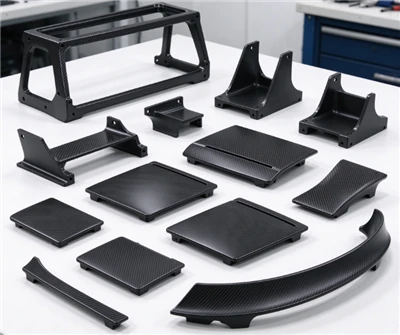



Why Choose a Custom Carbon Fiber Landing Gear Leg
Standard metal or off-the-shelf landing gear components often fail to meet the exact needs of specialized aircraft or UAV projects. Common limitations include excessive weight, incompatible mounting interfaces, or insufficient strength-to-weight performance.
A custom Carbon Fiber Landing Gear Leg allows precise control over:
Overall weight
Load-bearing capacity
Geometric shape and length
Mounting interface and bolt patterns
Surface finish and environmental protection
In real projects, many customers switch to custom carbon fiber solutions after discovering that standard aluminum or steel legs add unnecessary weight or require costly modifications. The goal is not simply to use carbon fiber, but to solve specific engineering problems with a practical, reliable component.
Product Features
High-strength carbon fiber composite construction with excellent strength-to-weight ratio
Significant weight reduction compared with equivalent metal legs
Good impact resistance and fatigue performance
Fully customizable length, cross-section, and taper
Flexible mounting interface design (bolt patterns, fittings, etc.)
Surface options: matte, glossy, protective coating, or custom color
Corrosion-resistant and suitable for outdoor operating environments
Available in one-piece or multi-part configurations
Engineered to meet defined static and dynamic load requirements
Application Fields
UAV / Drone landing gear systems
Light aircraft and sport aviation
Special-mission and experimental aircraft
Prototype and modification projects
Unmanned systems requiring aggressive weight reduction
Other structural applications where high strength and low weight are critical
Core Advantages
Genuine, measurable weight savings without compromising structural integrity
Full customization capability from design support to production
Controlled materials and processes for consistent batch performance
Practical engineering communication focused on real installation and load needs
Support for both prototype quantities and subsequent volume supply
Transparent development process with clear milestones
Customer Pain Points We Solve
| Common Pain Point | Our Approach |
|---|---|
| Metal landing gear legs are too heavy, reducing flight time or payload | Custom Carbon Fiber Landing Gear Leg provides real weight reduction while meeting strength targets |
| Existing components do not match the required mounting interface | Fully customizable geometry and interface design |
| Lack of reliable strength and weight data from some suppliers | Measured data and clear material/process information provided with samples |
| Long customization cycles and poor communication | Structured development process with direct technical discussion |
| Difficulty finding suppliers willing to support small prototype batches | Flexible support from sampling through volume production |
Information Required from the Customer
To develop an accurate and efficient solution, please provide as much of the following information as possible:
Aircraft or UAV type and primary mission
Target dimensions or existing drawings of the landing gear leg
Load requirements (static load, impact considerations, safety factor)
Target weight range
Mounting interface details and mating components
Operating environment (temperature, outdoor exposure, etc.)
Estimated quantities (prototype + future production)
Any special testing or documentation requirements
The more complete the initial information, the faster and more accurate the technical proposal will be.
Custom Development Process
Requirement discussion and data collection
Preliminary feasibility assessment and concept proposal
Detailed design and material/process confirmation
Sample manufacturing
Customer testing and feedback
Design optimization and finalization
Pilot production
Volume production and ongoing supply
We maintain clear communication at each stage so that expectations on timeline, cost, and performance remain aligned.
Company Advantages
We focus on carbon fiber structural components for aviation, UAV, and specialized equipment applications. Our strengths include:
In-house capability covering design support, molding, post-processing, and inspection
Practical experience working with international customers on lightweight structural parts
Emphasis on real performance data rather than marketing claims
Ability to support projects from first prototype through stable series production
A problem-solving approach: we prioritize whether the part fits, carries the load, and meets the weight target
We treat accurate weight, reliable strength, and dependable delivery as the foundation of long-term cooperation.
Frequently Asked Questions (FAQ)
Q1: How much weight can a Carbon Fiber Landing Gear Leg save compared with metal?
A: Weight reduction typically ranges from 30% to 50% depending on the design and load requirements. We provide measured weights for specific designs rather than general estimates.
Q2: How is structural strength ensured?
A: Strength is addressed through proper material selection, layup design, and process control. We can support basic load discussions and provide reference data with samples. Final validation remains the customer's responsibility according to their certification requirements.
Q3: What is the minimum order quantity? Do you support prototyping?
A: Yes, we support prototype and small-batch orders. MOQ for production depends on the complexity of the design.
Q4: How long does a typical customization project take?
A: Sample lead time is usually 3–6 weeks depending on complexity, followed by production lead time after sample approval.
Q5: What drawings or data do I need to provide?
A: Ideally, dimensional drawings, load requirements, and interface details. Even preliminary sketches or existing part photos can help start the discussion.
Q6: Can the surface be customized with color or logo?
A: Yes. Color, gloss level, protective coatings, and logo application are possible subject to process and quantity considerations.
Q7: Is the Carbon Fiber Landing Gear Leg suitable for long-term outdoor use?
A: Yes, when properly designed and finished. Protective coatings can be applied for additional environmental resistance.
Q8: How do you ensure consistency in series production?
A: Through controlled materials, standardized processes, and inspection. Key dimensional and weight parameters can be monitored across batches.
Ready to start your project?
Please share your preliminary dimensions, load requirements, or existing drawings. We will provide a free feasibility assessment and recommend the most practical path forward for your Custom Carbon Fiber Landing Gear Leg.
Hot Tags: carbon fiber landing gear leg, China carbon fiber landing gear leg manufacturers, suppliers, factory, construction carbon fiber sheet, environmental impact testing carbon fiber sheet, fabricated for precision carbon fiber sheet, riveted carbon fiber sheet, surface treated carbon fiber sheet, value for money carbon fiber sheet
Product Customization Options
Overall dimensions (length, diameter, cross-section profile)
Target weight and load requirements
Mounting interface and connection method
Surface finish (matte, gloss, coating, color)
Structural configuration (one-piece, segmented, locally reinforced)
Environmental protection requirements
Packaging and labeling preferences