
-
![Carbon Fiber Sheets]() Carbon Fiber SheetsWe produce custom carbon fiber sheets locally in China. Our team accepts OEM & ODM orders and can machine panels following your drawings for different industrial uses.We produce custom carbon fiber
Carbon Fiber SheetsWe produce custom carbon fiber sheets locally in China. Our team accepts OEM & ODM orders and can machine panels following your drawings for different industrial uses.We produce custom carbon fiber -
![Thin Carbon Fiber Plate]() Thin Carbon Fiber PlateThin Carbon Fiber Plate is developed for applications where extreme thickness control, weight reduction, and structural reliability are critical.
Thin Carbon Fiber PlateThin Carbon Fiber Plate is developed for applications where extreme thickness control, weight reduction, and structural reliability are critical. -
![Thick Carbon Fiber Sheets]() Thick Carbon Fiber SheetsIt is stronger than steel, lighter than aluminum, corrosion-resistant, fearless of harsh environments; Anti-shock, protect safety and stability; Cast quality with strength, and build a solid and
Thick Carbon Fiber SheetsIt is stronger than steel, lighter than aluminum, corrosion-resistant, fearless of harsh environments; Anti-shock, protect safety and stability; Cast quality with strength, and build a solid and -
![Color Carbon Fiber Plate]() Color Carbon Fiber PlateOur color carbon fiber plate combines the classic strength of carbon fiber with a variety of vivid colors, offering both high performance and aesthetic appeal for diverse applications.
Color Carbon Fiber PlateOur color carbon fiber plate combines the classic strength of carbon fiber with a variety of vivid colors, offering both high performance and aesthetic appeal for diverse applications. -
![Large Carbon Fiber Sheets]() Large Carbon Fiber SheetsWe provide full customization options for your needs, including sizes (up to 1200×4000mm), thicknesses (0.2-120mm), surface finishes (glossy, matte, or semi-matte), and optimized internal designs.
Large Carbon Fiber SheetsWe provide full customization options for your needs, including sizes (up to 1200×4000mm), thicknesses (0.2-120mm), surface finishes (glossy, matte, or semi-matte), and optimized internal designs. -
![Conductive Carbon Fiber Plate For EMI Shielding & Cleanroom Antistatic Enclosure]() Conductive Carbon Fiber Plate For EMI Shielding & Cleanroom Antistatic EnclosureElectrically conductive carbon fiber plate for EMI/RFI shielding.Antistatic surface option for cleanroom and medical imaging enclosures.3K twill / plain, gloss or matte, CNC cut ±0.05mm.Lightweight
Conductive Carbon Fiber Plate For EMI Shielding & Cleanroom Antistatic EnclosureElectrically conductive carbon fiber plate for EMI/RFI shielding.Antistatic surface option for cleanroom and medical imaging enclosures.3K twill / plain, gloss or matte, CNC cut ±0.05mm.Lightweight -
![Custom Wound Round Carbon Fiber Hollow Tube | T300 / T700 Grade For Robot & Automation Machinery]() Custom Wound Round Carbon Fiber Hollow Tube | T300 / T700 Grade For Robot & Automation ...We produce wound round hollow carbon tubes in our own factory. We customize sizes and surface finish following customer drawings or samples.Our carbon tubes serve robot, automation, drone, medical
Custom Wound Round Carbon Fiber Hollow Tube | T300 / T700 Grade For Robot & Automation ...We produce wound round hollow carbon tubes in our own factory. We customize sizes and surface finish following customer drawings or samples.Our carbon tubes serve robot, automation, drone, medical -
![China Factory Carbon Fibre Tube, Glossy Matte Surface Custom Composite Tubing]() China Factory Carbon Fibre Tube, Glossy Matte Surface Custom Composite TubingCustom carbon fibre tubes cured by autoclave vacuum system. 3K twill, forged carbon texture available. OEM & ODM service, custom OD, wall thickness, length for industrial, drone and robotic projects.
China Factory Carbon Fibre Tube, Glossy Matte Surface Custom Composite TubingCustom carbon fibre tubes cured by autoclave vacuum system. 3K twill, forged carbon texture available. OEM & ODM service, custom OD, wall thickness, length for industrial, drone and robotic projects. -
![Plain Weave Carbon Fiber Plate Stock | 200×200mm / 300×300mm Square Billet For CNC Machining]() Plain Weave Carbon Fiber Plate Stock | 200×200mm / 300×300mm Square Billet For CNC Mach...Real 3K plain weave carbon fiber square stock plates. Flat, rigid, clean-edge billet for CNC milling, router jigs, RC parts and fixture bases. Autoclave cured prepreg, no printed film.
Plain Weave Carbon Fiber Plate Stock | 200×200mm / 300×300mm Square Billet For CNC Mach...Real 3K plain weave carbon fiber square stock plates. Flat, rigid, clean-edge billet for CNC milling, router jigs, RC parts and fixture bases. Autoclave cured prepreg, no printed film. -
![Filament Wound Carbon Round Tube, Custom Sized T300 T700 Composite Hollow Tube]() Filament Wound Carbon Round Tube, Custom Sized T300 T700 Composite Hollow TubeWe produce filament wound carbon fiber round hollow tubes, customized according to customer drawings and samples.Our carbon tubes are widely applied in robot frames, automation equipment, drones and
Filament Wound Carbon Round Tube, Custom Sized T300 T700 Composite Hollow TubeWe produce filament wound carbon fiber round hollow tubes, customized according to customer drawings and samples.Our carbon tubes are widely applied in robot frames, automation equipment, drones and -
![2.5mm Carbon Fiber Plate]() 2.5mm Carbon Fiber Plate2.5mm carbon fiber sheet from a Chinese factory—combining high-strength performance with an attractive weave pattern.
2.5mm Carbon Fiber Plate2.5mm carbon fiber sheet from a Chinese factory—combining high-strength performance with an attractive weave pattern. -
![Flexible Carbon Fiber Board]() Flexible Carbon Fiber BoardWe provide customized TPU flexible carbon fiber boards with full support of size selection, thickness definition, texture style, and surface finish. Made of carbon fiber cloth and flexible TPU resin
Flexible Carbon Fiber BoardWe provide customized TPU flexible carbon fiber boards with full support of size selection, thickness definition, texture style, and surface finish. Made of carbon fiber cloth and flexible TPU resin


Guangdong Shenyang New Material Technology Co., Ltd., established in 2015, specializes in the application of carbon fiber. It is a high-tech enterprise integrating R&D, production, and sales. Carbon fiber sheets, carbon fiber tubes, carbon fiber custom parts, and industrial custom carbon fiber products. With diverse product types and complete specifications, these products boast excellent performance, exquisite craftsmanship, and outstanding quality. Our products are widely used in fields such as low-altitude economy drones, aviation accessories, high-end sports equipment, precision medical devices, automotive components, and 3C electronic accessories, earning widespread acclaim and trust in the market.
Introduction to Carbon Fiber Sheet
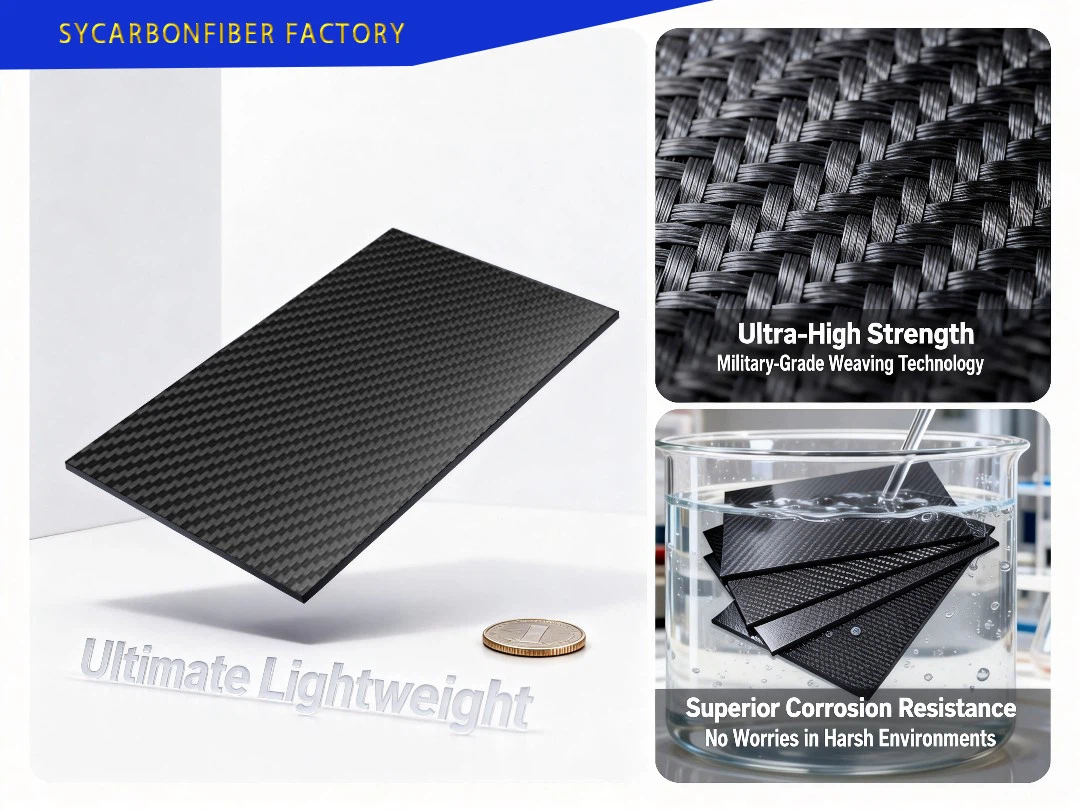
A carbon fiber sheet is a product that is known for its advanced properties such as high strength, durability and lightweight status. It is composed of thin carbon fibers which are woven into a fabric. The fabric is then infused with a strong and stable resin which results in a highly rigid and strong composite material.
Advantages of Carbon Fiber Sheet
High Tensile Strength and Stiffness
The strength of carbon fiber comes from the reinforcing fibers: thousands of microscopic strands of bonded carbon which by themselves are strong in tension, but lack stiffness and resistance to compression. By suspending them inside epoxy resin they become stiff along their axis and strong in both tension and compression. This makes carbon fiber a great replacement for metals like aluminum and steel because it's strength can be tailored exactly to its load scenario.
Lightweight
Speaking of weight, carbon fiber is light! A carbon fiber reinforced plastic isn't much heavier than a non-reinforced plastic. When compared to steel, the overall weight reduction is about ninety percent. A 70 pound steel car hood can be re-created to weight a mere 7 pounds! It's lighter than aluminum and even titanium.
Doesn't Rust
Most materials react poorly to air and water, corroding, oxidizing, or simply breaking down unless protected. Not carbon fiber. Both the carbon and the epoxy resin are extremely stable and non-reactive, even when submerged in water!
Resistant to Chemicals
Carbon fiber is typically used in unison with a polymer matrix. Most commonly carbon fiber is paired with an epoxy resin system. Epoxy is formed from a two-part chemical reaction of a resin and a hardener. Once cured, epoxy is a thermoset that will not melt or return to its former constituents.
Good Heat Conductor
At the atomic level, carbon fiber is composed of the same material that forms charcoal—carbon. Due to a property know as thermal conductivity, heat is readily conducted along the length of the fibers. Heat doesn't conduct perpendicularly to the fibers which allows the flow of heat to be controlled through the part by arranging the direction of the fibers to create the desired thermal properties.
Visual Appearance and Aesthetics
If there's one attribute nearly everyone knows about carbon fiber, it's the instantly recognizable look. Whether it's a super-car made almost entirely of carbon, a simple accent on a piece of furniture, or simply a wallet or knife you carry every day, carbon fiber is beautiful, striking, and bold. Carbon fiber can now even be woven into other patterns or with other materials to add some color. Carbon fiber by itself cannot be any color other than black.
Application of Carbon Fiber Sheet


Automotive Uses
Carbon fiber's strength and durability make them valuable in the automotive industry. Therefore, car manufacturers use it in the construction of vehicle frames. For instance, carbon fiber reduces vehicle weight by removing unnecessary metal pieces. This reduces fuel consumption and CO2 emissions.
Carbon fiber also makes vehicle manufacturing cheaper. Other materials like aluminum would significantly increase the production costs.
Decoration and Interior Design
Designers can create new shapes and models using carbon fiber. This allows them to make innovative and functional decor items like watches.
Its strength makes it ideal for kitchen utensils and furniture elements.
Carbon fiber sheets are commonly used for making picture frames and light fixtures. The material has a unique look compared to other materials. It gives a modern, futuristic feel to rooms, without the harshness metal or glass brings.
Sporting Equipment
Many professional athletes use carbon fiber sheet in their sporting equipment. This includes helmets, golf clubs, bicycle frames, bicycle wheels, and others.
Carbon fiber application in sports is due to its lightweight.
It is lighter than metal, plastic, and wood. This makes it easier for athletes to carry their equipment. Athletes can therefore run faster, and swim farther.
Carbon Fiber Sheets Use in Aerospace
Carbon fiber is widely used in the aircraft industry Carbon fiber has reduced the weight of airplanes.
Military Equipment
Military-grade armor such as ballistic shields and armor use carbon fiber for production. They reinforce high-strength parts such as struts, doors, and cabins.
When creating guns or knifes out of carbon fiber, they cut the desired shape out of the carbon sheet. The edges are then smoothed down to ensure safety and fit together nicely.
Finally, pieces are placed into the oven and baked at high temperatures until cured. Therefore, resulting with strong, lightweight pieces of equipment ready to be used.
Why Choose Us?
Strong Capital
We have three production bases in Huizhou, Guangdong, China covering a total area of over 8,000 square meters. These include: Carbon fiber plate production plant, Carbon fiber flat panel CNC Processing plant, Carbon fiber custom parts processing plant.
Product Applications
Our products are widely used in fields such as low-altitude economy drones, aviation accessories, high-end sports equipment, precision medical devices, automotive components, and 3C electronic accessories, earning widespread acclaim and trust in the market.
Quality Assurance
The company's products are certified by ISO 9001 and European CE and ROHS standards, ensuring that quality, safety, and environmental protection meet international standards.
Company Mission
Shenyang Technology always adheres to the corporate spirit of "seriousness, efficiency, and integrity," committed to providing products and services that exceed expectations.
Carbon fiber is a material made from thin filaments of carbon atoms bonded together in a crystalline structure, which results in an exceptional strength-to-weight ratio. The manufacture of carbon fiber material involves several complex steps that transform carbon-rich precursors into spools of fibers.
Most carbon fibers are produced using polyacrylonitrile (PAN), pitch, or rayon as the precursor. The selected precursor material is first spun to create long fibers. The raw fibers are then heated in an oxygen-free environment in a process called stabilization to prevent them from burning or shrinking. After stabilization, the fibers are carbonized at a very high temperature of around 1000 - 3000 degrees Celsius in an inert atmosphere such as nitrogen. This drives out almost all non-carbon elements from the fibers leaving behind almost pure carbon atoms in a crystalline structure. Finally, the fibers receive a surface treatment to enhance their adhesion to matrix materials and then wound onto spools.
How Carbon Fiber Sheet Is Produced?
The manufacturing process of carbon fiber sheets involves several sophisticated steps that are essential for achieving their remarkable properties. These steps ensure the creation of a material that is both incredibly strong and lightweight, suitable for a wide range of high-performance applications.
Unlike conventional materials such as steel or aluminum, carbon fiber sheets are produced through complex processes involving polymerization, spinning, and weaving. One of the most prevalent methods is the Layup technique, where thin layers of carbon fiber are stacked and impregnated with resin to form a composite material. This method allows for precise control over the fiber orientation, enhancing the material's strength and stiffness.
Filament Winding is another key production method. This involves winding continuous carbon fibers around a rotating mandrel to create cylindrical or spherical structures. This technique is particularly useful for manufacturing pipes, tanks, and other hollow components that require high strength-to-weight ratios. The fibers are typically impregnated with resin during the winding process, which is then cured to form a solid composite.
Prepreg processing is also widely used, where carbon fibers are pre-impregnated with resin before being laid into molds and cured under heat and pressure. This method ensures a consistent resin-to-fiber ratio, leading to high-quality composites with excellent mechanical properties. Prepreg materials are often used in aerospace and automotive industries due to their superior performance.
The Pultrusion method is used for continuous production of composite profiles with constant cross-sections. Carbon fibers are pulled through a resin bath and then through heated dies, where the resin cures to form solid profiles. This method is efficient for producing large volumes of structural components like beams and rods.
Autoclave processing is another advanced technique where layup composites are cured in a pressurized oven. This process ensures uniform pressure and temperature, leading to high-strength composites with minimal voids. Autoclave processing is commonly used in the aerospace industry for critical components that require exceptional performance.
FAQ
As one of the most professional carbon fiber sheet manufacturers and suppliers in China, we're featured by quality products and good service. Please rest assured to wholesale customized carbon fiber sheet from our factory. Contact us for free sample.
plain carbon fiber sheet, secure carbon fiber sheet, rectangular carbon fiber sheetPopular Products


