

1. Core Advantages - Five Mission Conditions, Five Design Responses
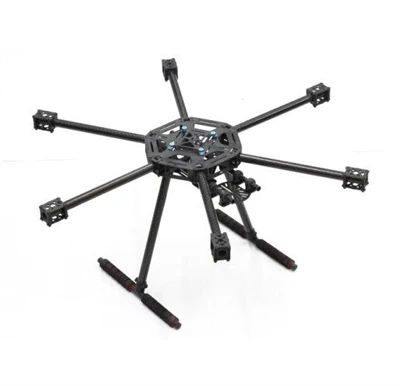
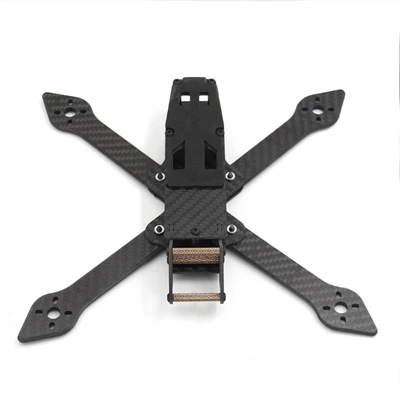
Mission 1: Long endurance with heavy sensors. Every gram off the airframe goes to battery or payload. Carbon fiber plates are the main stiffness contributor in the frame (~1.5 g/cm³ vs. aluminum 2.7) - the frame stays light while the load couple between plates and standoffs does the stiffening work.
Mission 2: Fast deployment in the field. Foldable/quick-assembly architecture: the airframe packs into a small transport case and goes together without custom tools. Patrol teams don't set up in a hangar.
Mission 3: Sensor stability near transmission lines. IMU and payload mounts use isolated interfaces - a frame that transmits motor vibration straight into the gyroscope or gimbal produces bad data in the air, not just bad footage.
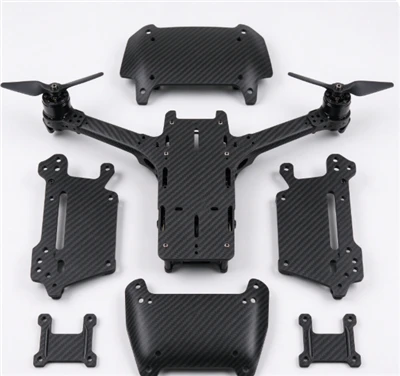
Mission 4: Field-repairability. Arms, top plates and mounts are modular and separately replaceable. A crash in a corridor shouldn't ground the whole aircraft - spares ship as a kit.
Mission 5: Outdoor corrosion and thermal range. Carbon fiber doesn't rust; the airframe holds its dimensions across patrol-season temperature swings, with CTE around 0.2–1.0 ×10⁻⁶/°C - stable from winter inspections to summer heat.
2. Parameter Table - Typical Mission Configuration Matrix
| Mission class | Recommended MTOW | Typical payload | Structural focus |
|---|---|---|---|
| Light patrol (corridor walk-through) | ~7 kg | ~3 kg gimbal camera | Foldability, fast setup |
| Medium inspection (power line / pipeline) | 20–25 kg | 5–8 kg gimbal + LiDAR | Payload bay, vibration isolation |
| Heavy long-endurance (hybrid) | 45–55 kg | 8–30 kg multi-sensor | Carbon body + aluminum nodes, redundant architecture |
Material & structure rows (typical):
| Parameter | Typical value | Note |
|---|---|---|
| Main structure | Carbon fiber plates + 7075 aluminum joints | Hybrid where bolts/hinges concentrate load |
| Frame weight | ~3.8 kg class (medium airframe) | Varies by MTOW class |
| Folded size | ~350 × 370 × 420 mm class | Light patrol class |
| Payload interface | Standard gimbal / sensor mounts, custom on request | RTK mast, camera bay |
| Operating temperature | Carbon itself stable; adhesive/joints limit | |
| CTE (axial) | 0.2–1.0 ×10⁻⁶/°C | Dimensionally stable |
Typical industry values; locked from your layout, measured sample and batch reports.
3. Customization - Platform + Modules
We build on a modular base platform; you select the mission modules:
Payload bay - gimbal, LiDAR, gas sensor or thermal camera interface, sized to your equipment.
Arm configuration - length, fold/quick-release, motor mount spacing per your propulsion choice.
Landing gear - fixed, retractable or skid, matched to takeoff weight.
Antenna mast / RTK mount - position per your RF layout (we design geometry; your RF team validates near-field performance).
Vibration-isolated mount plate - for IMU and sensitive sensors.
Send the STEP/DWG or your equipment list; we return a DFM review before cutting - stack-up, fold kinematics, and where carbon meets aluminum nodes.
4. Company Advantages
We engineer the frame around the patrol mission, not around a generic kit.
Carbon-aluminum hybrid know-how. Carbon carries panel loads; aluminum nodes carry bolt and hinge loads - the right material at the right joint, not all-carbon where it delaminates.
Field-spares thinking. Modular arms and plates mean your maintenance kit is small and your aircraft stays on route.
One factory for sheet and CNC. Material batch traceable; reorders match the approved sample; inspection report ships with the order.
Export experience. Serving [UAV integrators /inspection service companies /equipment OEMs] in [markets, 需补充]; certifications [ISO 9001 等,需补充].
Our boundary. We build the airframe structure. Flight control, RTK integration, EMI validation near live lines and airworthiness remain the integrator's job - and we'll say so when the question comes up.
5. FAQ - Field Questions
Q: Does a carbon frame interfere with communication near high-voltage lines? Carbon fiber is conductive; antenna placement and near-field validation are RF-engineering tasks. We design the frame geometry around your antenna positions - your RF team validates performance. We won't claim EMI immunity from a frame.
Q: How field-repairable is the frame after a hard landing? Arms, plates and mounts are modular and sold as spares kits. Replace the damaged module, not the whole aircraft.
Q: What about rain, dust and temperature range? Carbon fiber is corrosion-free; the limiting factors are seals, adhesives and electronics enclosures - designed per your environment spec.
Q: Can you integrate my gimbal / LiDAR / RTK layout? Send the equipment drawings; we size the payload bay, mount points and isolated plate around them.
Hot Tags: carbon fiber inspection drone frame power line pipeline survey uav frame for industrial patrol, China carbon fiber inspection drone frame power line pipeline survey uav frame for industrial patrol manufacturers, suppliers, factory, carbon fiber aerodynamic design for drones, carbon fiber antenna mounts for drones, carbon fiber durability performance for drones, carbon fiber orientation performance for drones, carbon fiber turbulence resistance performance for drones, carbon fiber waterproofing for drones