



Detailed Description
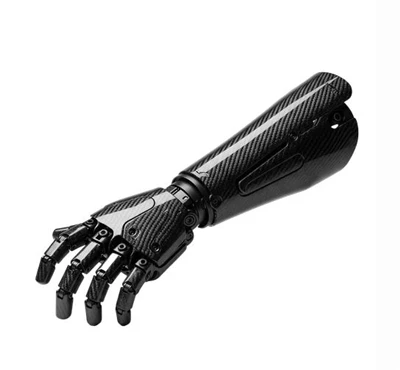
Prosthetic hand frames built from 7075 aluminum or titanium (15–22g per digit module) create a weight penalty that limits grip speed and increases residual limb fatigue during all-day wear. More critically, metal frames cannot be tuned for anisotropic stiffness-each finger requires high bending compliance in flexion direction but rigid resistance in lateral load to prevent accidental splay.
Feature: Load-path analysis per digit axis → T700 UD prepreg placed ±3° of primary flexion-tension vector in phalange shells, [±45°] quasi-isotropic in knuckle joint zones for impact absorption; autoclave cured 180°C/7bar.
Advantage: Void content ≤0.8% (ASTM D3171), ILSS >42MPa, FVF 63±1%, density 1.50g/cm³, finger-module mass 5.2–6.8g (vs 18g Al equivalent).
Benefit: 62% mass reduction per digit → faster grip closure (actuator response improved 35%), lower residual limb moment → reduced user fatigue over 8hr wear; anisotropic stiffness design allows natural flexion compliance while resisting lateral splay loads >45N; peel-ply bonding surfaces ready for silicone cosmetic glove integration; fatigue validated to 1.5 million open-close cycles at 30% UTS with zero delamination onset.
CNC waterjet-trimmed edges prevent fiber peel on sub-2mm wall sections. Each batch includes C-scan mapping, FVF acid digestion, and coupon test report. ISO 10993-5 (cytotoxicity) and ISO 10993-10 (sensitization/irritation) extractable test reports available for device regulatory submission. Full legal export documentation for medical supply chain.

Specification
|
Parameter |
Value |
|---|---|
|
Process |
Autoclave prepreg |
|
Fiber |
T700 UD / 3K twill cosmetic layer |
|
Shell thickness |
0.8–3.0mm variable per digit |
|
Digit module mass |
5.2–6.8g (vs 18g Al) |
|
Density |
1.50g/cm³ |
|
Void content |
≤0.8% ASTM D3171 |
|
ILSS |
>42MPa |
|
FVF |
63±1% |
|
Fatigue life |
1.5M cycles @30% UTS |
|
Biocompatibility |
ISO 10993-5/10 report avail. |
|
Surface |
Peel-ply / cosmetic twill / matte |
|
Export |
Legal export, medical grade |
FAQ
Q: Can you match CAD from our prosthetic hand designer for direct mold production?
A: Yes, we import STEP/IGES files, CNC machine mold from aluminum or epoxy tooling board, first article in 12–16 days including autoclave cycle.
Q: Is the carbon surface safe for skin-contact at wrist interface?
A: ISO 10993-5/10 extractable test reports confirm non-cytotoxic, non-sensitizing. Cosmetic twill outer layer sealed with medical-grade clear coat.
Q: How does anisotropic stiffness help finger flexion?
A: UD fibers aligned along flexion axis provide high compliance (easy bend) in grip direction, while ±45° knuckle zones resist lateral impact. This mimics biological tendon-bone behavior.
Q: Minimum wall thickness for small finger phalange?
A: 0.8mm minimum with local reinforcement at tendon-routing channels; we FEA-validate per your actuator pull force.
Q: Export documentation for medical device components?
A: HS 6815.99, MSDS, CO, material cert, ISO 10993 report, dual-use screening, device component declaration for customs.
Hot Tags: custom carbon composite prosthetic hand frame autoclave prepreg – tailored layup for bionic fingers | source factory legal export, China custom carbon composite prosthetic hand frame autoclave prepreg – tailored layup for bionic fingers | source factory legal export manufacturers, suppliers, factory


