


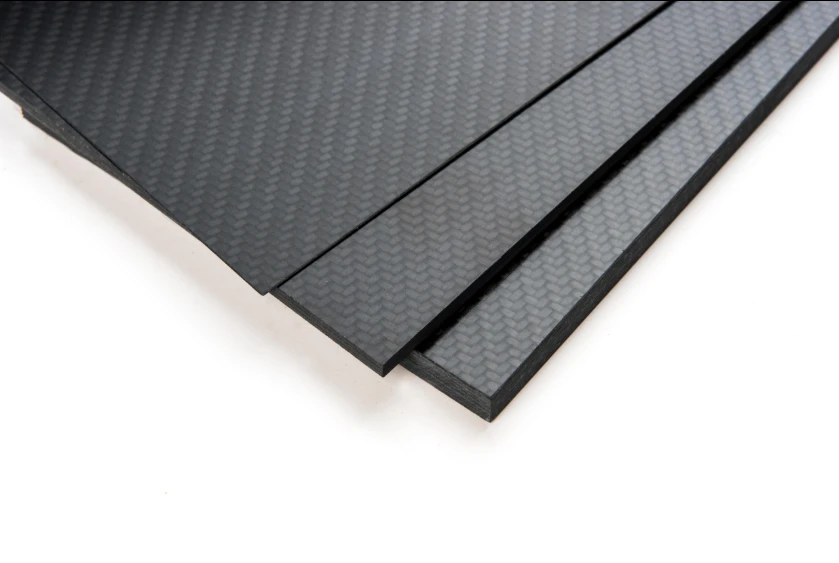
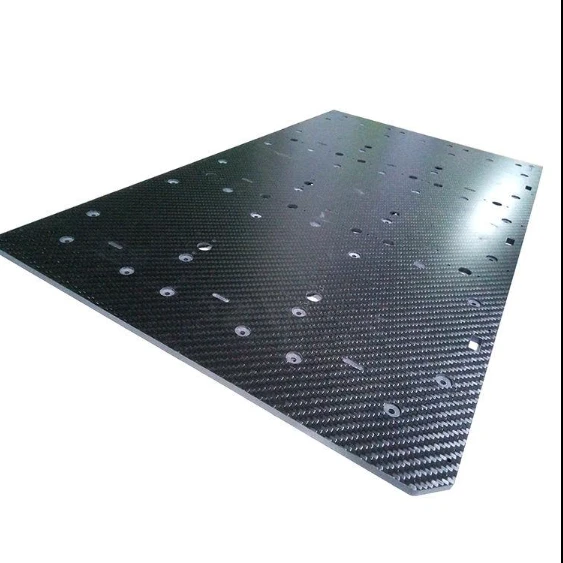

Core Advantages
Near-zero thermal expansion: Typical in-plane CTE as low as 0.3 × 10⁻⁶/K (or lower with optimized high-modulus layups), far superior to aluminum (≈23 × 10⁻⁶/K) and steel (10–12 × 10⁻⁶/K).
Exceptional specific stiffness: Density of 1.55–1.60 g/cm³ combined with flexural modulus of 50–70 GPa delivers high rigidity at significantly reduced weight.
Superior dimensional stability: Maintains shape and accuracy through repeated thermal cycles, ideal for precision measurement and optical systems.
Design flexibility: Quasi-isotropic or tailored fiber orientations allow customization of CTE in specific directions.
Additional benefits: Non-magnetic, low moisture absorption, excellent fatigue resistance, and corrosion-free performance.
These advantages make the Low Thermal Expansion Carbon Fiber Plate a preferred solution for engineers seeking reliable performance without the weight or cost penalties of traditional metals.
Specifications & Custom Options
Standard thicknesses: 0.5 mm, 1 mm, 2 mm, 3 mm, 5 mm, 10 mm, 20 mm (tolerance ±0.1 mm)
Standard sizes: 500 × 500 mm, 1000 × 1000 mm, 1200 × 2400 mm (larger sizes available on request)
Surface finishes: Glossy, matte, one-side gloss / one-side matte, or peel-ply for secondary bonding
Fiber options: Standard modulus, intermediate modulus, or high-modulus carbon fiber
Layup configurations: Quasi-isotropic, unidirectional, or custom ply angles
Resin systems: Standard epoxy (−40 °C to +120 °C), high-Tg epoxy, or cyanate ester for higher temperature applications
Custom services: CNC machining, drilling, water-jet cutting, special surface treatments, CTE matching to specific requirements, and vacuum integrity testing.
We support both stock availability for standard plates and fully customized Low Thermal Expansion Carbon Fiber Plate solutions with flexible MOQs and competitive lead times.
Customer Pain Points & Solutions
Pain point 1: Metal plates expand and contract with temperature, causing loss of precision in optical, metrology, or machining applications.
Solution: The Low Thermal Expansion Carbon Fiber Plate maintains near-zero dimensional change, ensuring consistent accuracy.
Pain point 2: Invar is heavy, expensive, and difficult to machine.
Solution: Our plates offer comparable or better thermal stability at a fraction of the weight and with easier machining, reducing overall system cost.
Pain point 3: Aluminum lacks sufficient stiffness or requires complex thermal management systems.
Solution: Higher specific stiffness allows lighter designs and reduced need for active cooling or temperature control.
Pain point 4: Difficulty obtaining reliable data and consistent quality from suppliers.
Solution: We provide transparent technical data, material test reports, and engineering support from material selection through final machining.
Why Choose Us?
With years of experience supplying high-performance carbon fiber composites to aerospace, optics, and precision equipment manufacturers in Europe, North America, and Japan, we understand real-world requirements. Our expertise in controlling fiber orientation and resin systems enables precise CTE optimization. Every Low Thermal Expansion Carbon Fiber Plate is produced under strict quality control, with traceable data and reliable delivery. We focus on delivering measurable performance rather than empty claims - samples, test reports, and technical consultation are readily available.
FAQ
Q1: How low can the CTE be achieved?
A: Typical values start from 0.3 × 10⁻⁶/K. With high-modulus fibers and optimized layups, near-zero CTE is achievable. Test reports can be provided.
Q2: Can you match a specific CTE target?
A: Yes. We design the layup and material combination according to your required CTE values.
Q3: What is the maximum size and thickness available?
A: Standard maximum size is approximately 1200 × 2400 mm; thickness ranges from 0.5 mm to 25 mm. Larger dimensions can be evaluated with joining solutions.
Q4: Is the plate machinable?
A: Fully machinable by CNC, water-jet, or conventional tools. The low CTE properties remain after machining.
Q5: How does it compare cost-wise to aluminum or Invar?
A: While the unit price is higher than aluminum, the overall system cost (weight reduction, eliminated thermal management, higher precision) is often lower. It is significantly more cost-effective than Invar in most precision applications.
Q6: What about lead time and samples?
A: Standard plates are available from stock. Custom plates typically ship in 2–4 weeks for samples. Small trial orders are welcome.
Q7: Do you provide material certificates or test data?
A: Yes. Mechanical property reports and CTE test data are available. Specific certifications can be discussed based on project requirements.
Hot Tags: low thermal expansion carbon fiber plate, China low thermal expansion carbon fiber plate manufacturers, suppliers, factory, clamped carbon fiber sheet, dielectric strength testing carbon fiber sheet, flexibility testing carbon fiber sheet, tailored to fit specifications carbon fiber sheet, temporary carbon fiber sheet, thickness measurement carbon fiber sheet
Technical Parameters
| Property | Typical Value | Notes / Test Reference |
|---|---|---|
| Density | 1.55–1.60 g/cm³ | - |
| In-plane CTE | 0.3–2.5 × 10⁻⁶/K | Optimized high-modulus grades lower |
| Tensile strength (quasi-iso) | 600–900 MPa | ASTM D3039 |
| Flexural modulus | 50–70 GPa | ASTM D790 |
| Fiber volume content | ≥ 60 % | - |
| Operating temperature | −50 °C to +120 °C | Higher with special resins |
| Water absorption | ≤ 0.2 % (24 h) | ASTM D570 |
All values are based on actual production data and can be verified with test reports upon request.


