


Which Is Stronger: 3K or 12K Carbon Fiber? In-Depth Comparison and Applications
With the widespread use of carbon fiber materials in drones, robotics, automotive, aerospace, and more, many engineers and procurement professionals are asking: "Which is stronger, 3K or 12K?" Especially when customizing carbon fiber sheets or tubes, choosing the right type of carbon fiber not only affects structural strength, but also directly impacts cost, appearance, and service life. In this article, we'll dive deep into the differences between 3K and 12K carbon fiber from multiple perspectives-fiber structure, mechanical performance, appearance, application scenarios, and manufacturing advice-to help you make a smart choice.
What Are 3K and 12K Carbon Fiber?
What does K mean?
"K" refers to the number of filaments per tow of carbon fiber. 1K = 1,000 filaments. So 3K has 3,000 filaments per tow, and 12K has 12,000.
Same raw material, different bundle density
3K and 12K often use the same grade of carbon fiber precursor (e.g., T300, T700), but the tow size leads to significant differences in density and weave style. 3K is finer and more flexible-ideal for detail work. 12K is thicker and more robust-better for high-strength components.
Weaving differences
3K is commonly used in plain weave or twill weave fabrics, offering a smoother, tighter surface. 12K fabrics are coarser due to thicker bundles, often used in thicker panels or large structural parts.
Mechanical Performance: Which Is Stronger?
We're often asked, "Which is stronger?" But "strength" can refer to several metrics-tensile strength, rigidity, impact toughness, interlaminar bonding, and more. Here's a practical comparison:
|
Property |
3K Carbon Fiber |
12K Carbon Fiber |
|
Tensile Strength |
Generally higher |
Slightly lower |
|
Bending Stiffness |
Slightly lower |
Higher |
|
Impact Toughness |
Better |
Slightly lower |
|
Interlayer Bonding |
Better (more uniform layup) |
Slightly weaker |
|
Weight Control |
Lighter, for lightweight design |
Heavier, better for load-bearing |
Fiber Volume Ratio and Structural Behavior
One key difference lies in the fiber volume ratio (FVR). 3K fabrics offer tighter weaves, enabling higher FVR, which enhances tensile and flexural strength. Meanwhile, 12K bundles create more resin-rich zones, which might reduce mechanical uniformity but are beneficial in cost-sensitive bulk applications.

Heat Resistance and Fatigue Life
Both 3K and 12K use PAN-based carbon fiber precursors, giving them excellent thermal stability. However, in high-cycle fatigue tests, 3K laminates tend to perform better due to more uniform stress distribution across smaller filament bundles.

Appearance and Processing Differences
Appearance: 3K has a finer and more delicate weave, ideal for high-end products. 12K appears coarser, giving an "industrial look."
Machinability: 3K cuts cleaner with smoother edges and allows for higher processing precision. 12K's thickness and rigidity demand better tooling and techniques.
Surface Finishing Options: Both 3K and 12K can be finished in gloss, matte, semi-transparent resin, or prepreg laminates-allowing flexible visual effects based on the product.
Delamination Resistance: Due to tighter packing and better resin impregnation, 3K laminates exhibit superior interlaminar shear strength, making them more durable under stress cycling and vibrations.
Application Scenarios: Which Should You Choose?
Best Use Cases for 3K Carbon Fiber:
High-end sports gear (racing parts, bikes, rackets)
Lightweight drone components (arms, shells, gimbals)
Industrial covers or enclosures with appearance requirements
Medical frames, lab fixtures, or testing jigs
Best Use Cases for 12K Carbon Fiber
Load-bearing parts in industrial automation
Large robot platforms, gripper base plates
Automotive crash protection structures, reinforcements
Aerospace jigs or support beams
Case Study: UAV Arm Testing
We recently delivered two sets of carbon fiber drone arms-one in 3K, one in 12K-to a European client. Under impact tests, the 3K version absorbed shock better and returned to shape faster, while the 12K version maintained lower deflection under static loads. This highlights the trade-off: toughness versus rigidity.
Customization Tips and Factory Insights
With 12 years of carbon fiber manufacturing experience, our factory has served clients in over 40 countries across industries like UAVs, robotics, automotive, and medical. These are the most common concerns from our clients:
1. Size Limitations
We can produce carbon fiber sheets up to 1200mm × 4000mm. Both 3K and 12K are available in custom sizes.
2. Thickness and Layer Control
We offer sheets from 0.2mm to 20mm thick. 3K is better for thin sheets (≤2mm), 12K suits thicker sheets (≥3mm).
3. CNC Machining
For CNC machining, 3K offers better precision and cleaner edges-ideal for fine mechanical parts.
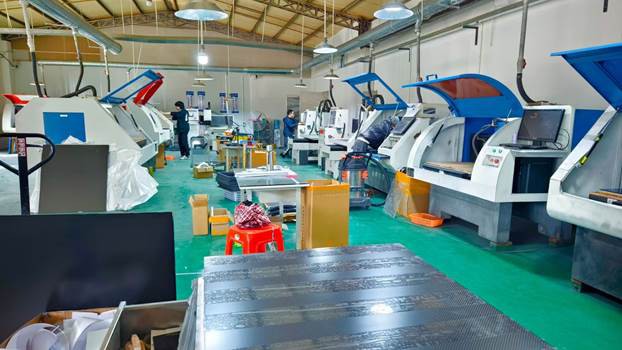
Related Service: Learn more about our CNC Carbon Fiber Cutting Services
4. Surface and Aesthetics
Choose from gloss, matte, or satin finishes. 3K is more often used in visible parts, while 12K is ideal for structural pieces.
5. Cost Difference
For the same size, 12K has a lower material cost than 3K. But 3K shines in secondary processing, assembly, and display.
6. Lead Time and Availability
Standard 3K sheets are often in stock due to high demand. 12K may require specific layups, especially in custom thicknesses, resulting in longer lead times.
FAQ: Common Questions from Buyers
Q1: Can I mix 3K and 12K layers in one part?
A: Yes, hybrid layups are common in performance design. For instance, 3K surface layers combined with 12K core plies offer both appearance and strength.
Q2: Is 3K better for curved or contoured surfaces?
A: Absolutely. 3K is more flexible and drapes better over molds, making it ideal for complex geometries.
Q3: How do I choose between prepreg and wet layup?
A: Prepregs offer consistent quality, especially with 3K fabrics. Wet layup is more cost-effective for thick 12K panels. We provide both options.
Conclusion: There's No One-Size-Fits-All "Stronger" – The Right Fit Matters
|
Feature |
3K Carbon Fiber |
12K Carbon Fiber |
|
Aesthetics |
★★★★★ |
★★★ |
|
Tensile Strength |
★★★★★ |
★★★★ |
|
Rigidity |
★★★★ |
★★★★★ |
|
Cost Efficiency |
★★★ |
★★★★★ |
|
Machining Precision |
★★★★★ |
★★★ |
|
Thin Sheets |
★★★★★ |
★★ |
|
Thick Sheets |
★★ |
★★★★★ |
Final Advice:
Choose 3K if you need a balance between aesthetics and performance.
Choose 12K if your priority is structural rigidity, thickness, and cost control.
For any carbon fiber customization needs, feel free to contact our engineering team. We'll provide detailed drawing reviews and material recommendations tailored to your project.
Need help choosing the right material for your design? Talk to our engineers today.


